50 Fruits Coloring Book Printable
Learning vocabulary doesn’t have to mean flashcards, drills, or screen time. For educators, homeschooling parents, and ESL instructors seeking a joyful, low-pressure way to reinforce fruit-related language, the 50 Fruits Coloring Book Printable offers a refreshingly simple yet powerful solution. This no-prep resource transforms vocabulary practice into a creative, multisensory experience—where coloring isn’t just a pastime, but a cognitive tool that supports word recognition, spelling, and long-term retention.
Many adults supporting early learners face common challenges: short attention spans, resistance to traditional worksheets, inconsistent engagement with new words, or difficulty bridging visual recognition with written spelling—especially for English language learners. Young children may know the word “banana” when they see it in a picture book, but struggle to recall its spelling or distinguish it from similar-sounding words like “mango” or “papaya.” Meanwhile, teachers juggling literacy centers, differentiated instruction, and limited prep time need materials that are flexible, inclusive, and immediately usable. That’s where the 50 Fruits Coloring Book Printable steps in—not as a filler activity, but as an intentional learning strategy grounded in educational research on visual encoding and kinesthetic reinforcement.
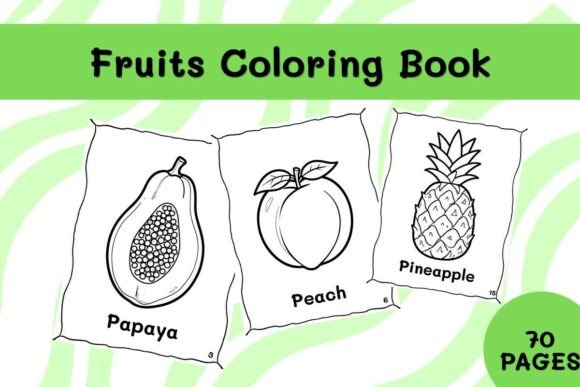
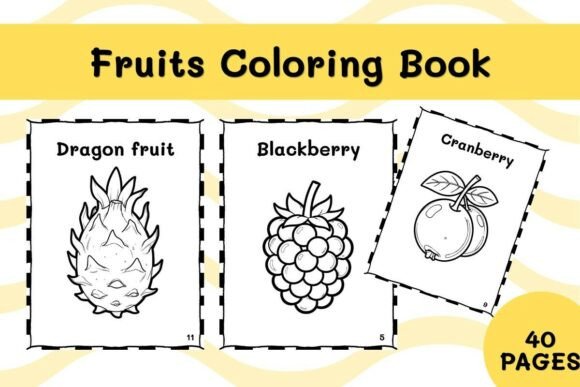
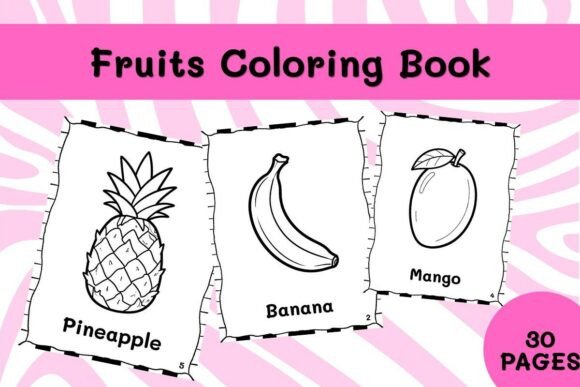
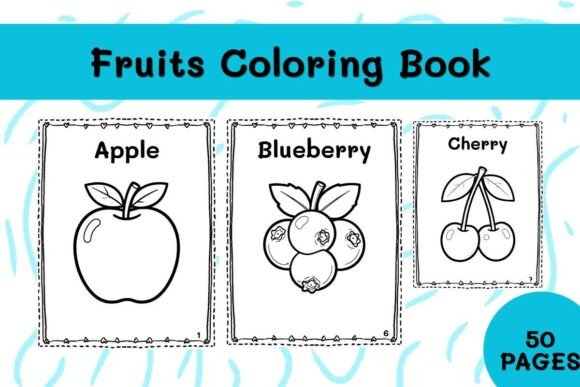
Each of the 50 pages features a clearly illustrated, line-drawn fruit—ranging from familiar staples like apples, oranges, and strawberries to less commonly highlighted options such as dragon fruit, starfruit, rambutan, and ackee. Beneath each image appears the fruit’s name in clean, legible font—designed for early readers and emerging spellers. Because the pages are sized at 8.5 x 11 inches and delivered as a ready-to-print PDF, there’s no formatting hassle, no cutting, no laminating—just open, print, and hand out. That immediacy makes the 50 Fruits Coloring Book Printable ideal for spontaneous teaching moments, substitute lesson plans, or last-minute literacy center rotations.
In practice, this resource supports multiple learning goals simultaneously. As students color a detailed kiwi illustration, they’re not only practicing fine motor control—they’re reinforcing the connection between the word “kiwi,” its phonetic structure (/kī-wē/), and its physical characteristics (fuzzy brown skin, bright green flesh with black seeds). For ESL learners, pairing the visual with the printed word builds semantic networks more effectively than isolated vocabulary lists. For struggling readers, repeated exposure across 50 distinct fruits strengthens orthographic mapping—the brain’s ability to link letters to sounds and store words for automatic recognition.
Here’s how different users can tailor the 50 Fruits Coloring Book Printable to their unique needs:
- Classroom Teachers: Use individual pages as morning warm-ups, fast-finisher activities, or part of a thematic unit on nutrition or seasons. Group similar fruits (e.g., citrus, tropical, berries) and invite students to compare and contrast features—spelling patterns (“-berry,” “-ine”), plural forms (“cherries,” “grapes”), or vowel sounds (“pear” vs. “peach”).
- Homeschool Families: Integrate pages into daily routines—color one fruit per day while discussing where it grows, how it’s eaten, or what color it is in real life. Add extension prompts: “Can you write one sentence using this word?” or “Draw something else that’s the same color.”
- ESL/EFL Instructors: Pre-teach 5–7 fruits per session. Display the coloring page, say the word slowly, have students repeat and trace the letters, then color. Later, use the same pages for spelling quizzes or matching games (cut out the words and pictures separately).
- Special Education Support Staff: Leverage the high-contrast line art and consistent layout to support visual processing. Pair coloring with verbal labeling, tactile tools (e.g., textured crayons or stickers), or AAC device integration.
What sets the 50 Fruits Coloring Book Printable apart from generic coloring sheets is its pedagogical intentionality. Every fruit was selected to represent diverse global foods—not just Western grocery staples—supporting cultural awareness alongside language development. The clean, uncluttered design avoids visual overload, making it accessible for neurodivergent learners. And because it’s entirely offline and screen-free, it encourages focused attention without digital distractions—a growing priority for many caregivers and educators.
Practical implementation is straightforward—but small adjustments can deepen impact. Consider printing two copies of select pages: one for coloring, one for cutting out and labeling (e.g., “stem,” “skin,” “seeds”) or sorting by color, size, or origin. Laminate a few favorites for reusable tracing practice. Or turn completed pages into a classroom “Fruit Dictionary”—a student-made reference wall that grows over time. These extensions require no extra purchase—just thoughtful use of what’s already included in the 50 Fruits Coloring Book Printable.
It’s also worth noting how this resource aligns with evidence-based practices. Dual coding theory tells us that combining verbal and visual information improves memory. Handwriting and coloring activate motor pathways that strengthen neural connections to new vocabulary. And because the activity feels playful—not evaluative—students engage with lower anxiety, which research shows enhances language acquisition, especially for second-language learners.
If you’ve tried other vocabulary resources that fell flat—whether due to complexity, lack of visual clarity, or mismatched reading levels—you’ll appreciate how the 50 Fruits Coloring Book Printable meets learners where they are. It doesn’t assume prior knowledge, doesn’t overwhelm with text, and doesn’t require special training to use well. Its strength lies in its simplicity, consistency, and quiet effectiveness.
Whether your goal is to reinforce spelling during independent work time, build confidence in beginning readers, support oral language development through descriptive talk (“Look how spiky the pineapple is!”), or simply offer a meaningful, calming activity that still delivers academic value—the 50 Fruits Coloring Book Printable delivers measurable outcomes without demanding extra effort from you. It’s literacy support disguised as creativity. Learning disguised as play. And sometimes, that’s exactly what makes the difference.