30 Vegetables Coloring Book Printable
Learning vocabulary doesn’t have to mean flashcards, drills, or screen time. For educators, ESL instructors, homeschooling parents, and literacy specialists, the 30 Vegetables Coloring Book Printable is a purpose-built tool that fits cleanly into existing language development workflows—without requiring setup, digital access, or lesson planning overhead. It’s not a standalone “fun activity” tacked onto instruction; it’s a tactile, low-cognitive-load reinforcement layer designed to support word retention, spelling accuracy, and visual-word association during critical early literacy stages.
Where This Fits in Your Teaching or Learning Workflow
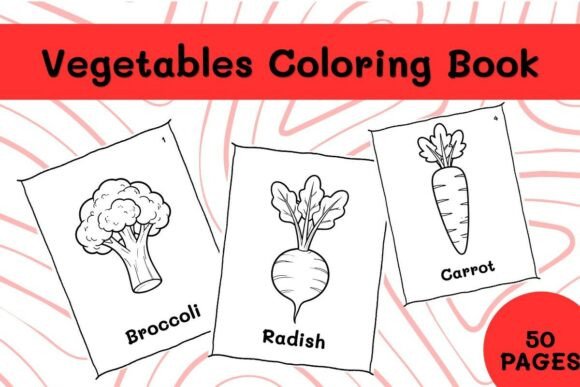
The 30 Vegetables Coloring Book Printable functions most effectively when integrated as a consistent, repeatable touchpoint—not as an occasional reward or filler task. In classroom settings, it works well as a literacy center rotation: students cycle through reading, writing, listening, and coloring stations. Each vegetable page serves dual roles—visual anchor and spelling reference. The image of “eggplant,” for example, isn’t just labeled; its syllables are spaced clearly (“egg-plant”), supporting phonemic awareness alongside vocabulary exposure.
For ESL learners, especially those with limited English immersion outside class, repetition matters. Coloring provides motor engagement that helps encode new words more durably than passive viewing. When learners color “kale” while saying it aloud and tracing the letters, they’re activating auditory, visual, and kinesthetic pathways simultaneously—a multisensory loop that strengthens neural connections. That makes this printable especially useful during vocabulary introduction (as guided practice), after a lesson (for independent review), or even before a themed unit on nutrition or gardening (to prime familiarity with key terms).
Compatibility With Existing Systems and Tools
This resource was built for interoperability—not isolation. Its 8.5 x 11 inch PDF format prints cleanly on standard office printers, integrates with learning management systems (LMS) like Google Classroom or Canvas via downloadable links, and holds up well when photocopied for large groups. No software installation, no login, no device dependency. That matters when you’re managing mixed-device classrooms, limited tech access, or multilingual families who may not navigate digital platforms confidently.
It also complements other foundational tools: pair it with a vegetable-themed word wall, use completed pages as part of a personal vocabulary journal, or laminate them for reusable tracing practice. Teachers report success combining the coloring pages with simple sentence frames (“I like ___.” / “___ is green.”) to scaffold early writing. Homeschoolers often staple finished pages into a custom “Vegetable Dictionary” booklet—adding drawings, definitions, or even photos from grocery trips. That kind of organic extension happens because the design leaves room for adaptation, not because it prescribes one rigid method.
Practical Implementation Tips for Real Workflows
Start small, scale intentionally. Don’t assign all 30 pages at once. Instead, select 3–5 high-frequency vegetables aligned with your current theme (e.g., “carrot,” “pea,” “corn” for a farm unit). Introduce one per day, using the coloring time to reinforce pronunciation, spelling patterns, and categorization (“Which ones grow underground?”).
Leverage consistency over variety. Revisit previously colored pages weekly—not to recolor, but to quiz: “Point to the one that starts with ‘b’,” or “Which one rhymes with ‘pear’?” This spaced repetition builds long-term recall without extra prep. You’ll notice students begin self-correcting spelling errors on their own as familiarity grows.
Use it for differentiation without extra work. Struggling spellers benefit from tracing the printed word before coloring. Advanced learners can add adjectives (“crunchy cucumber”) or write a full sentence beneath each image. Since every page is identical in structure—clear image + bold label + ample white space—the same resource supports multiple readiness levels without needing separate versions.
Quality Control and Long-Term Usability
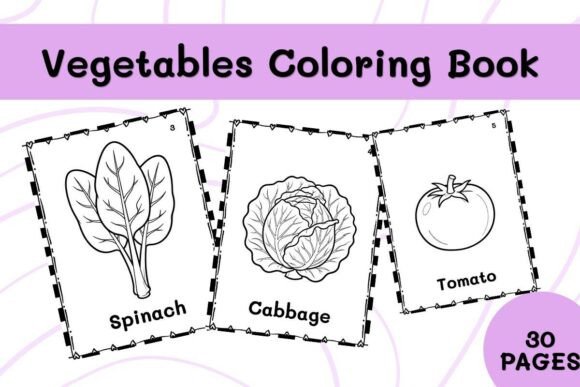
The 30 Vegetables Coloring Book Printable avoids common pitfalls of generic clipart-based resources. Illustrations are clean-lined, age-appropriate, and botanically recognizable—not cartoonish or ambiguous. “Leek” looks distinct from “onion”; “rutabaga” isn’t mistaken for “turnip.” That visual precision supports accurate word-picture mapping, which is essential for vocabulary acquisition, especially among learners still building conceptual categories.
Typography is equally intentional: sans-serif font, generous letter spacing, and consistent capitalization (all lowercase except proper nouns, matching early literacy conventions). There’s no decorative text that competes with legibility—just functional, accessible type. And because it’s delivered as a single, well-organized PDF, version control isn’t an issue. You won’t find mismatched fonts, broken links, or missing pages mid-print job.
Integration Into Broader Goals—Beyond Vocabulary
While vocabulary is the stated focus, this printable quietly supports several adjacent outcomes. Fine motor development improves through controlled coloring within lines—especially helpful for learners with developing hand strength or coordination. Visual discrimination sharpens when distinguishing similar-looking vegetables like “celery” vs. “rhubarb” or “zucchini” vs. “cucumber.” Even basic data literacy emerges when students sort completed pages by color, size, or where the vegetable grows (root, vine, leaf).
For curriculum designers and small publishers, this resource demonstrates how to build “no-prep” assets that serve real pedagogical needs—not just convenience. Its modularity means it can be excerpted, remixed, or embedded into larger units (e.g., a “Healthy Eating” digital workbook or a bilingual food glossary). That flexibility increases reuse value across grade bands, subject areas, and delivery formats.
What Makes This More Than Just Another Coloring Sheet
Most free vegetable coloring pages prioritize cuteness over cognition. They might feature smiling carrots or dancing peas—but those distractions dilute learning focus. The 30 Vegetables Coloring Book Printable removes novelty noise and centers utility: each page exists to clarify, reinforce, and retain. There’s no hidden agenda, no upsell, no external dependencies. It assumes you’re already doing meaningful work—and simply hands you a reliable, quiet tool that slots in without friction.
That reliability extends to long-term use. Pages hold up to repeated handling, erasing, and laminating. The PDF remains usable year after year—even as student cohorts change or curricula evolve—because its core function (connecting word, image, and spelling) stays constant. You’re not buying a trend; you’re acquiring infrastructure.
Final Consideration: Your Role in the Process
This printable doesn’t replace teaching—it amplifies it. Its effectiveness depends on how thoughtfully you position it within your rhythm. Use it to slow down a fast-paced lesson. Use it to give quiet processing time after group discussion. Use it to assess emerging spelling confidence without formal testing. The most impactful implementations aren’t the flashiest—they’re the ones where the resource disappears into the background, doing steady, unobtrusive work while you focus on what only a human educator can provide: observation, feedback, and responsive guidance.
If you’ve used the 30 Vegetables Coloring Book Printable in a way that solved a specific workflow challenge—like bridging a vocabulary gap in a multilevel ESL class or supporting reluctant writers in a homeschool setting—a 5-star review helps others discover it faster. Those reviews directly inform updates, accessibility improvements, and future topic expansions. And if you haven’t yet explored related themes—like fruit, kitchen tools, or food groups—you’ll find those resources follow the same no-prep, high-clarity standard.