50 Vegetables Coloring Book Printable
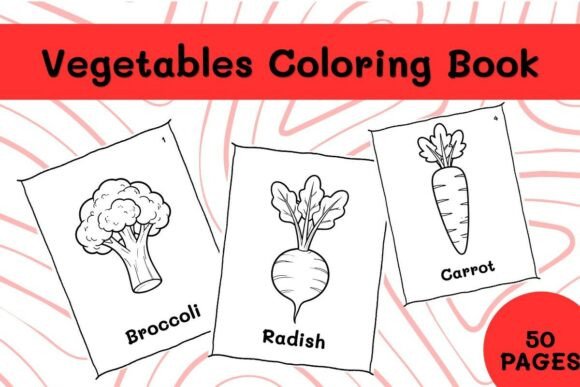
A well-designed printable resource can quietly elevate learning—especially when it bridges visual engagement with vocabulary development. The 50 Vegetables Coloring Book Printable is one such tool: a straightforward, no-prep PDF set that delivers 50 original line-art illustrations of vegetables, each paired with its corresponding word in clear, legible type. It’s not flashy software or an interactive app—it’s a purpose-built, print-ready collection designed for consistency, clarity, and classroom- or home-ready utility.
What It Is—and Why It Stands Out
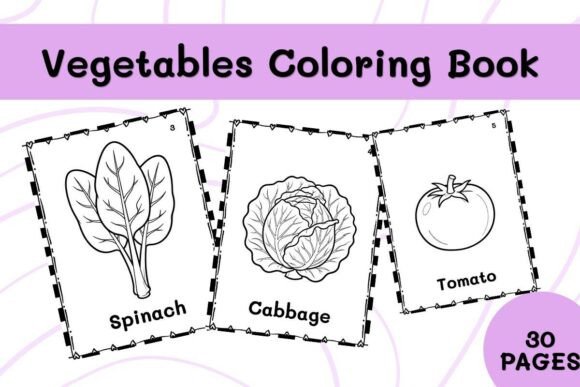
This isn’t a generic clipart compilation. Each page features a single vegetable (e.g., kohlrabi, fennel, okra, jicama) rendered in clean, uncluttered black-and-white line art—sized to standard 8.5 × 11 inches and optimized for crisp printing on standard office or home printers. The word appears beneath the image in uppercase sans-serif font, supporting early readers and English language learners without visual distraction. There are no instructions, no overlays, no layered elements—just image + label. That simplicity is intentional and functional.
Unlike many “educational” coloring pages that crowd layouts with borders, decorative frames, or secondary graphics, this set prioritizes focus. A child identifying “rhubarb” isn’t sidetracked by swirls or cartoon characters. An adult facilitating ESL practice can point directly to the term and image without decoding visual noise. That restraint supports cognitive load theory: reducing extraneous elements helps learners allocate attention where it matters most—word recognition and semantic association.
Practical Use Across Real Contexts
In literacy centers, educators report using the 50 Vegetables Coloring Book Printable as both a warm-up and reinforcement activity. One second-grade teacher uses three pages per week—introducing two new vegetables during morning circle, then assigning the third as independent coloring with a spelling check-in (“How many letters? Which sound does the ‘c’ make in ‘celery’?”). Another homeschooling parent rotates pages into weekly “vocabulary stations,” pairing them with taste tests or garden journaling—coloring the zucchini after harvesting one, for example.
For ESL instructors working with adult beginners or intermediate learners, the set functions well beyond beginner flashcards. Because all 50 vegetables are real-world, culturally relevant foods—not just carrots and tomatoes—the pages support nuanced discussion: “Which of these grow underground?” “Which are commonly pickled in your country?” “Which require peeling before cooking?” That opens natural opportunities for question formation, comparative adjectives, and verb collocations—all anchored in concrete visuals.
Design Quality and Consistency
The line work is uniformly precise—neither too thin (which risks breaking on low-resolution prints) nor overly thick (which limits fine-motor practice). Stroke weight remains consistent across all 50 pages, and spacing between image and text is identical. That uniformity matters: it means a student who colors “asparagus” on Monday experiences the same layout as “turnip” on Friday—supporting predictability, especially for neurodivergent learners or those developing visual processing routines.
Coloring area density also reflects thoughtful pacing. Leafy greens like spinach or kale include moderate internal detail—enough to encourage observation but not so much as to overwhelm. Root vegetables (beets, parsnips) feature simpler outlines, allowing younger users or those with motor challenges to complete pages successfully. No page feels rushed or underdeveloped; none rely on gimmicks to appear “engaging.”
Who Benefits Most—and When It Fits Best
The 50 Vegetables Coloring Book Printable serves specific audiences with precision:
- Classroom teachers seeking low-cost, reusable literacy supplements—particularly for science-integrated language units or nutrition-themed SEL lessons.
- ESL/EFL instructors building thematic vocabulary banks around food, health, or sustainability topics—with reliable pronunciation anchors (e.g., “quinoa” appears as spelled, avoiding phonetic approximations that may confuse).
- Homeschoolers and tutors needing structured, non-digital activities that align with Common Core Language standards (L.K.1, L.1.1, L.2.4) without requiring lesson planning.
- Occupational therapists and special educators incorporating fine-motor practice with vocabulary goals—especially for students whose IEPs include goals around labeling, categorization, or descriptive language.
It’s less suited for advanced learners needing contextual grammar practice or for digital-first classrooms without printing capacity. It also assumes access to basic coloring tools—colored pencils, crayons, or markers—and doesn’t include answer keys, extension questions, or audio support. That’s not a flaw; it’s a design boundary. Its value lies in what it *doesn’t* try to be.
Long-Term Utility and Workflow Integration
Because it’s delivered as a single PDF, the 50 Vegetables Coloring Book Printable integrates cleanly into existing systems. Educators upload it to learning management platforms (like Google Classroom or Canvas) as a downloadable assignment. Print shops batch-print sets for school-wide use. Homeschool co-ops split costs and share physical copies across families. There’s no subscription, no login, no device dependency—just file → print → use.
Users consistently note how often they revisit pages. One speech-language pathologist reuses the “cauliflower” and “artichoke” pages across multiple therapy goals: articulation (targeting /k/ and /tʃ/), category sorting (“Which ones are flowers?”), and pragmatic language (“Tell me how to choose a good one at the store”). That versatility emerges from fidelity to subject matter—not from added features, but from accurate, representative imagery and clean typography.
Realistic Considerations and Limitations
While the set covers 50 vegetables—including less common items like oyster mushrooms, bok choy, and plantains—it doesn’t include botanical classifications, nutritional facts, or growing zones. It’s strictly a vocabulary and labeling tool. If your goal is deep science integration or dietary education, you’ll need complementary resources.
Also worth noting: the PDF contains no editable layers or alternate versions (e.g., grayscale-only, cursive fonts, or bilingual labels). That keeps production lean and pricing accessible—but means customization requires external tools like Adobe Acrobat or Canva if you need adaptations.
Finally, while the file size is modest (~3 MB), users on older devices or slower connections should verify download stability before large-scale printing. A quick test print of the first five pages is advisable to confirm alignment and contrast settings on your specific printer model.
Final Assessment
The 50 Vegetables Coloring Book Printable succeeds by honoring its constraints. It doesn’t attempt to replace curricula, simulate apps, or entertain through novelty. Instead, it delivers exactly what its title promises—50 usable, well-executed vegetable coloring pages—designed to reinforce word-image connections with quiet consistency. Its strength lies in reliability, not reinvention. For educators, parents, and language facilitators who prioritize clarity, repetition, and tactile learning over bells and whistles, it earns steady, practical use—not as a novelty, but as infrastructure.