30 Desserts Coloring Book Printable
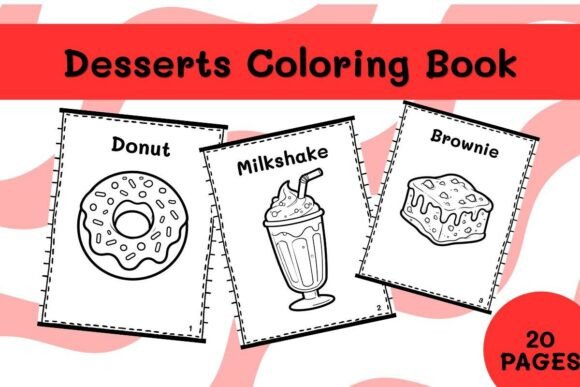
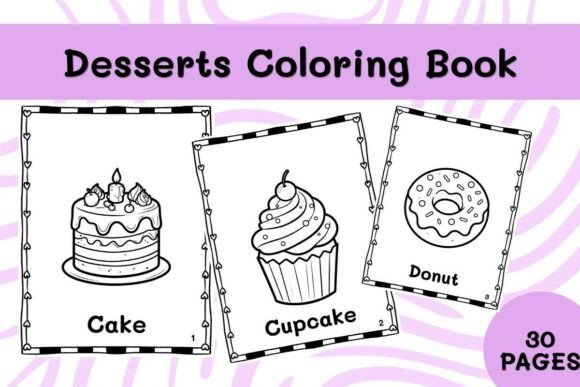
A well-designed printable resource can quietly shift how vocabulary instruction lands—especially when it bridges creativity with cognition. The 30 Desserts Coloring Book Printable is one such tool: a focused, no-prep set of 30 black-and-white illustrations centered exclusively on dessert-related vocabulary. It’s not a flashcard deck disguised as art, nor a generic activity pack padded with filler. Instead, it delivers consistent, intentional design—each page pairs a clear line drawing of a dessert (think: éclair, pavlova, baklava, or crème brûlée) with its correctly spelled, age-appropriate label. That pairing is where its utility begins.
What Makes This More Than Just “Coloring Pages”
At surface level, it’s a PDF file sized for standard 8.5 × 11-inch printing—nothing technically complex. But its value emerges from deliberate constraints: a single theme, controlled lexical scope, and visual clarity that supports word recognition without distraction. Unlike broader food-themed sets that mix fruits, proteins, and condiments, this one isolates desserts—a high-frequency, culturally rich category that offers natural scaffolding for phonics (e.g., silent letters in “gnocchi”), compound words (“ice cream”), and loanwords (“macaron”). For educators and curriculum designers, that specificity means less curation work and more predictable learning outcomes.
The illustrations themselves are clean, medium-detail line art—detailed enough to distinguish a soufflé from a mousse, but uncluttered enough for younger learners or those with fine motor challenges. There’s no shading, texture, or background noise. That isn’t a limitation; it’s a functional choice. It keeps attention anchored on the object–word relationship, not artistic interpretation. In practice, this means students aren’t guessing what’s being depicted—and teachers aren’t fielding questions like, “Is that a cupcake or a muffin?”
Real-World Use Cases and Workflow Fit
This resource integrates cleanly into several common instructional contexts without requiring adaptation:
- ESL/EFL classrooms: Learners at A1–B1 levels benefit from repeated exposure to concrete nouns paired with visual anchors. Using these pages during warm-ups, station rotations, or early finisher time builds automaticity without pressure. One middle school ESL teacher reported using three pages per week—first identifying, then spelling aloud, then coloring—resulting in measurable gains in written recall over six weeks.
- Literacy centers: In K–3 settings, the set complements phonemic awareness work (e.g., sorting desserts by initial sound: “tiramisu,” “tart,” “trifle”) or syllable counting (“choux,” “panna cotta”). Its uniform format allows for easy differentiation—some students label from memory; others match pre-cut word cards.
- Homeschool routines: Parents appreciate the lack of prep—no laminating, cutting, or digital setup. A homeschooling parent of two noted that her children used the pages alongside baking experiments: coloring a “scone” page before making scones, then revisiting it afterward to add descriptive words (“crumbly,” “buttery”) in the margin.
It also functions well outside formal instruction—as low-stakes vocabulary reinforcement for adult language learners, or as a tactile break during remote tutoring sessions where screen fatigue is real. One freelance English tutor shared that she emails one page ahead of each lesson; students color it while reviewing prior vocabulary, then discuss their choices (“Why did you make the flan yellow? What does ‘caramelized’ mean?”). That small ritual builds continuity and lowers affective filters.
Quality and Consistency Across the Set
All 30 pages maintain the same layout: centered illustration, bold title beneath, optional blank lines for writing practice (not forced, not omitted). No pages deviate into puzzles, mazes, or tracing—staying true to its core function. That consistency matters. In contrast to some printable bundles where half the pages are games and half are worksheets, this set avoids mission drift. You know exactly what you’re getting, and exactly how to use it.
File quality is reliable: crisp vector-based lines that scale without pixelation, even when enlarged for classroom projection. The PDF opens quickly, prints cleanly on standard office printers, and doesn’t require special fonts or software. There are no embedded links, interactive elements, or password protections—just straightforward, accessible content.
Who Benefits Most—and When It Might Fall Short
The 30 Desserts Coloring Book Printable serves practitioners who prioritize clarity, efficiency, and thematic coherence. Educators managing large class sizes or limited planning time will find its plug-and-play nature valuable. Curriculum coordinators selecting supplemental materials for units on food, culture, or holidays (e.g., integrating “mooncake” during Lunar New Year studies) will appreciate its cultural range—not just American staples, but globally recognized desserts like “halva,” “kheer,” and “mochi.”
That said, it’s not a comprehensive literacy system. It doesn’t teach grammar, sentence structure, or conversational phrases. It won’t replace leveled readers or diagnostic assessments. And if your goal is deep cultural exploration—say, comparing dessert traditions across regions—you’ll need to layer in additional resources. Likewise, learners beyond B2 proficiency may outgrow the single-word focus quickly; for them, the value shifts toward creative extension (e.g., writing recipes, comparing ingredients, debating health claims) rather than core vocabulary building.
Also worth noting: the set assumes access to basic coloring supplies and printer capability. While that’s standard for most schools and homes, it’s a real constraint for under-resourced settings or fully digital environments where printing isn’t feasible. There’s no editable version or Google Slides alternative included—so flexibility stops at the printed page.
Practical Recommendations for Implementation
To maximize impact, consider these evidence-informed approaches:
- Pair with multisensory input: Say the word aloud while pointing to the image, then have learners repeat with mouth shapes visible. Follow with coloring—engaging motor memory alongside auditory and visual channels.
- Use as a diagnostic baseline: Give one page at the start of a unit, then revisit the same page after two weeks. Compare spelling accuracy, confidence in pronunciation, and ability to generate related words (“sweet,” “baked,” “chocolate”).
- Extend beyond coloring: Cut out finished pages to create a classroom “dessert dictionary,” or use them as prompts for descriptive writing (“Describe the texture of a panna cotta using three adjectives”).
Finally, keep expectations grounded. This isn’t a magic tool—but it is a dependable one. Its strength lies in repetition, simplicity, and fidelity to purpose. When used intentionally—not as busywork, but as structured, low-pressure language practice—it supports retention in ways that flashcards alone often don’t.
For professionals evaluating tools for vocabulary development, the 30 Desserts Coloring Book Printable stands out not for novelty, but for execution: a tightly scoped, consistently designed, classroom-ready asset that respects both learner cognition and instructor time.