20 Bakery Coloring Book Printable
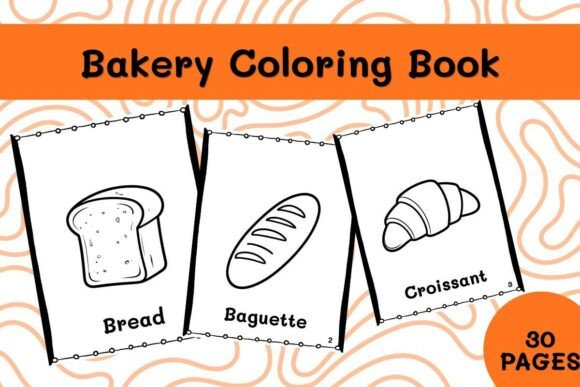
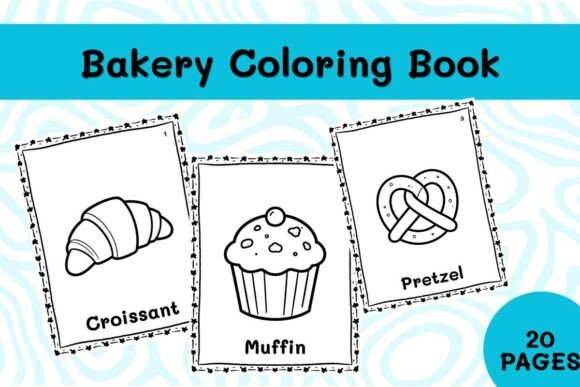
If you're designing for learning, literacy, or early language development — especially with young learners, ESL students, or homeschool families — the 20 Bakery Coloring Book Printable is more than a set of coloring pages. It’s a thoughtfully structured visual vocabulary tool that bridges creativity and cognition. Each of the 20 pages features clean line art centered around bakery-themed nouns: croissant, whisk, apron, oven mitt, baguette, cupcake, rolling pin, dough, baker’s hat, and more. The illustrations are friendly, uncluttered, and drawn with consistent stroke weight — not overly detailed, but expressive enough to support word recognition and contextual understanding.
The design leans into warmth and approachability without sacrificing clarity. There’s no heavy shading or complex gradients — just open outlines ready for crayons, colored pencils, or markers. That intentional simplicity isn’t accidental; it’s pedagogically grounded. Young eyes track clear shapes more easily, and emerging readers benefit from visual anchors that reinforce spelling and sound-letter relationships. The 8.5 x 11 inch layout fits standard printers and binders, and the PDF format ensures crisp output whether used in a classroom center, laminated for repeated use, or sent home digitally.
Where This Resource Fits in Real Creative Work
This isn’t just for teachers. Designers building educational apps, marketers launching kid-friendly food brands, publishers developing bilingual early-literacy series, or crafters creating themed activity kits will find immediate utility in the 20 Bakery Coloring Book Printable. Its strength lies in its adaptability across formats and audiences.
In editorial design, these pages serve as ready-made illustration assets — think magazine inserts, seasonal newsletters for bakeries, or printable sections for parenting blogs. For branding and packaging design, the consistent visual language supports cohesive merchandising: imagine pairing one of these illustrations with a custom label font on a cookie box or using the croissant page as a background texture for a café’s loyalty card.
Social media graphics gain authenticity when layered with real student work — post a photo of a child’s colored “baker’s hat” page next to your small-batch sourdough announcement. Bloggers covering ESL resources can embed a single page (with attribution) to demonstrate how vocabulary reinforcement works visually. Even web design benefits: educators embedding printable PDFs into learning management systems appreciate the zero-prep setup and predictable sizing.
Why Visual Consistency Matters More Than You Think
Consistency in illustration style builds trust and reduces cognitive load — especially for learners still forming associations between words and objects. The 20 Bakery Coloring Book Printable avoids stylistic whiplash: no mixing of cartoonish, realistic, and abstract renderings across pages. That uniformity supports memory retention and helps students focus on vocabulary, not decoding inconsistent visuals.
From a brand identity perspective, this kind of cohesion signals intentionality. If you’re developing a literacy program or launching an educational product line, using a resource like this — where every image feels like part of the same family — strengthens perceived professionalism. Parents and teachers notice that. So do school district curriculum coordinators reviewing supplemental materials.
It also simplifies scaling. Need five more bakery-themed pages? You’ll know exactly what line weight, spacing, and detail level to match — because you’ve already got 20 reference points. That saves hours in asset creation or briefing freelance illustrators.
Practical Tips for Getting the Most Out of These Pages
Before printing or integrating into your project, consider these real-world checks:
- Test readability at scale: Print one page at 75% size. Does the text (if added) remain legible? Do outlines stay distinct? This matters if you plan to shrink pages for flashcards or digital thumbnails.
- Check contrast for accessibility: Run a quick grayscale test. Do key shapes hold up without color cues? This ensures usability for learners with color vision differences.
- Evaluate font pairings carefully: If adding labels or instructions, avoid overly decorative typefaces. A clean sans serif (like Open Sans or Lato) pairs naturally with the hand-drawn warmth of these illustrations — supporting clarity without competing.
- Review commercial use rights: While the listing states it’s no-prep and ready to print, confirm whether redistribution or resale (e.g., bundling into your own paid activity pack) is permitted under the license. Most such resources allow classroom and personal use, but commercial derivatives often require explicit permission.
More Than Just Coloring — It’s Strategic Visual Learning
Vocabulary acquisition isn’t just about memorizing definitions. It’s about building mental models — linking sounds, spellings, meanings, and images. The 20 Bakery Coloring Book Printable supports that process by giving learners agency: they choose colors, fill space, make decisions. That active engagement boosts retention far more than passive worksheet completion.
For designers and content creators, that means this resource isn’t filler — it’s functional scaffolding. Use it to prototype lesson flow, test visual hierarchy with real users, or build out a themed content calendar. A single page can anchor a week of instruction: Monday, name and color the “mixing bowl”; Tuesday, trace the word; Wednesday, draw your own version; Thursday, write a sentence; Friday, share with a partner.
And because it’s delivered as a print-ready PDF — no fonts to install, no layers to unlock, no software dependencies — it removes friction for time-strapped educators and non-designer creators alike. That practicality is rare. Respect it.
If you’ve used the 20 Bakery Coloring Book Printable in a way that surprised you — maybe in a pop-up literacy event, a bilingual storytime kit, or even as inspiration for a small-batch bakery’s kids’ menu — that’s the sign it’s working as intended: quietly, effectively, and without fanfare.