Watercolor Butterfly PNG Clipart: A Versatile Creative Resource for Designers and Makers
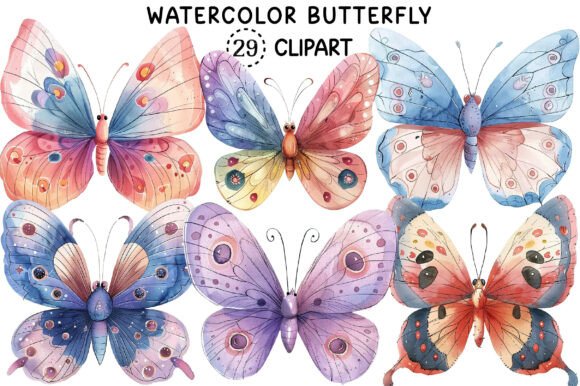
Watercolor butterfly PNG clipart has emerged as one of the most adaptable digital design assets across creative industries—from independent crafters printing custom greeting cards to small-batch apparel brands launching seasonal collections. Unlike generic vector butterflies or stock photography, watercolor-rendered butterflies carry organic texture, subtle pigment variation, and soft edges that evoke natural elegance without appearing clinical or overprocessed. When delivered as high-resolution PNG files with transparent backgrounds—like the curated set of 29 images described in this resource—they become functional tools rather than decorative afterthoughts.
Why Transparency and Resolution Matter in Real-World Use
The technical specifications of a clipart collection directly shape its practical utility. Each file in this Watercolor Butterfly PNG Clipart set is rendered at high resolution (typically 300 DPI or higher), ensuring crisp output whether scaled for a business card or enlarged across a 24-inch canvas print. More critically, every image includes a fully transparent background—no white boxes, no embedded shadows, no forced cropping. This isn’t just aesthetic convenience; it’s foundational functionality.
Consider a t-shirt designer preparing artwork for screen printing or direct-to-garment production. A non-transparent butterfly would require manual masking in Photoshop—adding time, introducing edge artifacts, and risking inconsistency across colorways. With true transparency, the butterfly drops cleanly into layered mockups, aligns precisely with fabric textures in digital previews, and retains integrity when placed over gradients or photographs in Canva or Adobe Express. Similarly, educators building printable science worksheets can overlay watercolor butterflies onto diagrams of pollination cycles without obscuring labels or lines.
Commercial Flexibility Without Legal Friction
One of the most consequential features of this Watercolor Butterfly PNG Clipart collection is its explicit commercial license. Users are permitted to incorporate these graphics into physical products—including mugs, pillows, backpacks, hoodies, plates, and greeting cards—as well as digitally finished works like digital planners, birthday invitation suites, or scrapbooking kits. The license extends to print-on-demand platforms such as Printful, Redbubble, and Zazzle, where creators upload designs and fulfill orders without handling inventory.
This clarity eliminates common friction points: no need to track usage tiers, no ambiguous “personal use only” restrictions, and no requirement to attribute the source. For entrepreneurs testing product concepts, that means rapid iteration—designing five mug variations before lunch, uploading them to a Shopify store integrated with a POD service, and launching a soft test campaign—all without pausing to verify licensing boundaries.
What “Commercial Use Allowed” Actually Enables
- Physical merchandise: Print butterflies on cotton tote bags using heat-transfer vinyl, embroider them onto linen napkins, or etch them onto ceramic coasters.
- Digital deliverables: Embed them in Notion templates sold on Gumroad, layer them into Canva-based wedding planner kits, or animate them for educational video thumbnails.
- Hybrid applications: Combine watercolor butterflies with hand-lettered quotes in Procreate, export as layered PSDs, then sell the resulting design bundle as an editable resource for other creators.
Note that permission applies only when the graphics are meaningfully incorporated—not reproduced in isolation. Reselling the PNG files themselves, distributing them as free downloads, or packaging them unchanged as “clipart bundles” violates the terms. But transforming them—blending with original illustrations, integrating into pattern repeats, or adapting proportions for character-based storytelling—is not only allowed but encouraged.
Workflow Integration Across Common Tools and Platforms
Because these files are standard PNGs, they function natively across virtually all design, publishing, and prototyping environments. No special plugins or converters are needed. In Figma, they paste cleanly with alpha channels preserved; in Cricut Design Space, they import as cut-ready images with no background removal step; in Microsoft PowerPoint or Google Slides, they resize responsively while maintaining edge softness—ideal for classroom presentations on biodiversity or nature-themed slide decks for nonprofit outreach.
Hobbyists using Silhouette Studio will appreciate how the lack of background simplifies contour cutting—especially for delicate wing outlines. Meanwhile, teachers building interactive PDFs in Adobe Acrobat can place watercolor butterflies as clickable elements that reveal fun facts about Lepidoptera anatomy, turning static handouts into tactile learning experiences.
Adaptation Over Replacement
These aren’t “plug-and-play” decorations meant to stand alone. Their value multiplies when treated as raw material—not final art. A surface pattern designer might extract the wing shape from one butterfly, rotate and mirror it, then scatter dozens across a seamless repeat for wallpaper or fabric. A children’s book illustrator could trace the silhouette, simplify the line weight, and recolor it to match a custom character palette—retaining the watercolor essence while making it unmistakably their own.
Even subtle adjustments yield distinct outcomes: adjusting blend modes in Photoshop (e.g., Multiply over a kraft paper texture) creates depth; applying light Gaussian blur in Affinity Designer simulates atmospheric perspective for layered scene-building; converting to grayscale and increasing contrast makes them effective for monochrome embroidery digitizing.
User Scenarios Where This Resource Delivers Tangible Value
Craft Business Owners: A small Etsy shop specializing in nature-inspired home goods uses three different butterflies from the set to create cohesive collections—each printed on matching sets of ceramic mugs, linen tea towels, and wooden coasters. Consistency across SKUs strengthens brand recognition, while the shared watercolor aesthetic ties disparate items into a unified story.
Educational Content Creators: A biology educator licenses the Watercolor Butterfly PNG Clipart to illustrate a downloadable unit on metamorphosis. Rather than sourcing separate photos for egg, larva, pupa, and adult stages, she overlays the butterfly onto stylized life-cycle infographics—keeping visual language consistent and reducing cognitive load for learners.
Event Planners & Stationers: For a spring garden wedding, a planner builds invitation suites in Illustrator using butterflies as repeating motifs along borders, as watermarks behind text, and as standalone icons on RSVP cards. Because all files share resolution and transparency standards, scaling between 5×7 inch printed cards and 48×72 inch welcome signage introduces no quality loss or alignment issues.
DIY Enthusiasts: Someone restoring vintage furniture scans a chipped drawer front, imports a butterfly PNG into GIMP, adjusts hue to match the existing finish, and prints it onto decal paper—transforming damage into intentional charm.
Practical Considerations Before Implementation
While flexibility is a strength, thoughtful implementation ensures longevity and professionalism. First, avoid overloading compositions: watercolor textures thrive in breathing room. A single large butterfly centered on a mug reads with quiet confidence; ten tiny ones scattered across the same surface can feel chaotic unless deliberately arranged as part of a rhythm or grid.
Second, consider context-driven color adaptation. Though the originals capture authentic watercolor behavior—pigment pooling, granulation, subtle halos—those traits may clash with certain substrates. A highly saturated blue butterfly may visually “vibrate” against a neon yellow hoodie unless muted slightly or paired with complementary neutral tones. Previewing in grayscale first helps assess value balance independently of hue.
Third, remember scalability limits. While high-resolution PNGs support substantial enlargement, extreme upscaling (e.g., stretching a 2000-pixel-wide butterfly to fill a 10-foot mural) risks revealing pixel structure. For architectural-scale applications, vector tracing—using the PNG as reference—preserves fidelity better than native raster expansion.
Instant Access, Zero Physical Overhead
This Watercolor Butterfly PNG Clipart collection operates entirely in the digital realm: no shipping costs, no inventory tracking, no fulfillment delays. Upon purchase completion, users receive immediate access to download all 29 files via a secure link—no login walls, no email verification loops. That immediacy supports time-sensitive projects: a last-minute teacher preparing Friday’s lesson, a designer responding to a client’s urgent revision request, or a maker fulfilling a flash-sale order.
Should technical issues arise—corrupted downloads, missing files, or format incompatibility—the support channel remains open and responsive. There’s no automated ticketing maze; real people review each inquiry and prioritize resolution speed over scripted responses. That human-centered reliability reinforces trust, especially for users who rely on these assets as part of repeatable workflows.
Final Thought: Utility Anchored in Authenticity
At its core, this Watercolor Butterfly PNG Clipart set succeeds not because it offers novelty, but because it delivers reliability wrapped in artistic authenticity. The watercolor treatment avoids sterile perfection—embracing slight irregularities that echo real-world media—while the technical execution (transparency, resolution, consistency) removes barriers between concept and execution. Whether used by a researcher illustrating ecological relationships, a child decorating a science fair poster, or a global brand developing limited-edition packaging, the underlying principle holds: great creative resources don’t demand adaptation from the user—they adapt gracefully to the user’s intent.