Tropical Coral Reef Ocean Bookmark: A Multifaceted Tool for Connection, Creativity, and Conservation Awareness
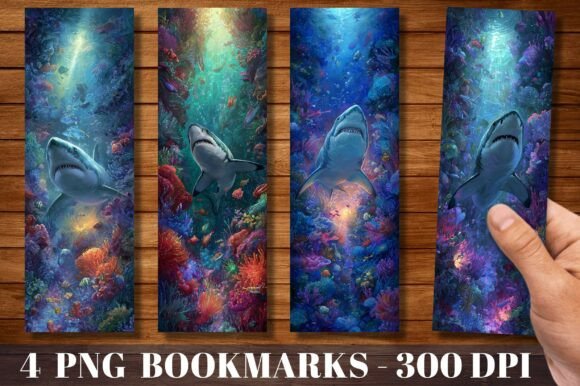
At first glance, the Tropical Coral Reef Ocean Bookmark appears as a simple printable—a vivid 2″ × 6″ digital artifact rendered at 600 px × 1800 px and 300 DPI. Yet its function extends far beyond paper-based page retention. This design bridges aesthetic intention with practical utility, ecological resonance, and social purpose. Unlike generic bookmarks, it carries layered meaning: a miniature window into marine biodiversity, a tactile prompt for reflection, and a versatile asset across professional, educational, and personal contexts.
Why Visual Design Matters in Everyday Learning Tools
Bookmarks are among the most frequently handled—yet least considered—learning aids. Research in cognitive psychology suggests that visual cues tied to emotional or environmental associations improve memory encoding and retrieval. A Tropical Coral Reef Ocean Bookmark leverages this principle intentionally. Its palette—turquoise gradients, coral pinks, seafoam greens, and subtle bioluminescent accents—mirrors real reef ecosystems while evoking calm, curiosity, and wonder. These aren’t arbitrary colors; they’re chromatic anchors rooted in marine science and sensory design.
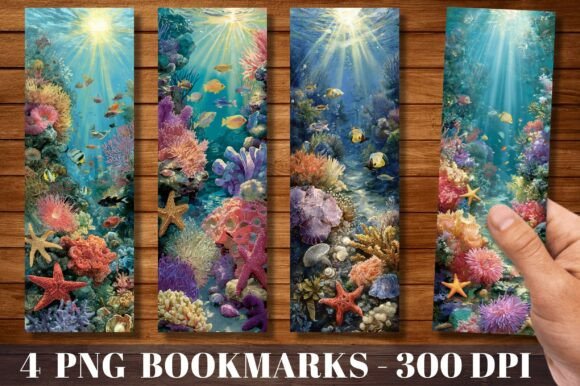
Each of the four included PNG files offers distinct compositional balance: one emphasizes branching stony corals with parrotfish silhouettes; another layers soft-focus anemones and sea fans behind translucent wave patterns; a third integrates subtle topographic contours reminiscent of underwater bathymetry; the fourth uses negative space and minimalist line art to suggest reef structure without overwhelming detail. This variation ensures adaptability—whether used by a child tracing coral shapes during storytime or a marine biology instructor illustrating habitat zonation.
Real-World Applications Across Diverse User Groups
The versatility of the Tropical Coral Reef Ocean Bookmark emerges most clearly when observed across settings—not as a monolithic product, but as a responsive tool shaped by user intent.
Educators and Curriculum Developers
In classrooms spanning elementary literacy to university-level environmental science, these bookmarks serve dual roles: engagement scaffolds and informal assessment prompts. Teachers print batches for students to annotate—labeling species, sketching food web connections, or writing reflections on ocean stewardship. Because the design avoids text-heavy elements, it invites open-ended interpretation. One middle school educator in Florida reported using the bookmarks as “exit tickets”: students wrote one thing they learned about reef resilience on the back before leaving class. The visual consistency across all four files enabled thematic continuity across units—from biodiversity to climate impacts.
Authors, Publishers, and Indie Creators
For writers whose work intersects with ecology, travel, adventure, or speculative fiction set in aquatic worlds, the Tropical Coral Reef Ocean Bookmark functions as authentic brand extension. It’s not merely promotional swag—it’s narrative reinforcement. A novelist releasing a climate-fiction thriller might include the bookmark in pre-order packages, pairing it with a QR code linking to a short essay on real-world coral bleaching events. The physicality of the item—its weight, texture when printed on cardstock, even the slight scent of ink—creates a multisensory bridge between story and reality. Unlike digital-only marketing, this tangible artifact lingers in readers’ hands—and minds—long after the last chapter.
Librarians and Community Program Coordinators
Public libraries increasingly curate “eco-literacy” collections and host sustainability-themed reading challenges. Here, the bookmark becomes both incentive and educational touchpoint. A summer reading program in Hawaii distributed the Tropical Coral Reef Ocean Bookmark alongside local tide pool identification guides. Patrons received one design per completed book, unlocking deeper content—such as interviews with Native Hawaiian marine knowledge keepers—via scannable elements added during local printing. The uniform size (2″ × 6″) ensured compatibility with standard library display racks and giveaway bins, while the high-resolution 300 DPI output preserved fine detail even when scaled for large-format posters.
Hobbyists, Gift Makers, and Small-Business Owners
Crafters appreciate the clean vector-friendly edges embedded in each PNG file—ideal for die-cutting, laminating, or embedding into resin coasters. Etsy sellers report bundling the bookmarks with handmade seashell journals or kelp-dyed cotton ribbons, positioning them as “ocean-conscious stationery.” For small-batch gift box curators, the bookmarks add unexpected sophistication to birthday hampers or holiday stockings—not as filler, but as intentional, conversation-starting elements. One coastal bookstore owner noted that customers often pause to examine the coral textures closely, sparking spontaneous conversations about reef conservation efforts in their region.
Technical Considerations for Optimal Use
Because this is a digital download, successful implementation depends on informed usage—not just printing. Understanding resolution, color fidelity, and material interaction is essential.
- Resolution & Scaling: At 600 px × 1800 px and 300 DPI, the files maintain crispness whether printed at full size or slightly enlarged (up to 110%) on home printers. Shrinking below 90% risks losing delicate textural nuance in coral polyps or water refraction effects.
- Color Management: While RGB previews on screens emphasize vibrancy, CMYK conversion during commercial printing may mute certain cyan and magenta tones. Users preparing bulk orders should request a hard-copy proof—especially when matching institutional branding or coordinating with other ocean-themed materials.
- Paper Choice Impacts Perception: Matte cardstock (110–130 lb) enhances the organic, handcrafted feel; glossy finishes intensify water-like sheen but may reduce writability. Recycled bamboo or seaweed-fiber papers align with the ecological ethos—though users should test ink absorption first, as natural fibers sometimes feather with pigment-based inks.
Ecological Literacy Through Repetition and Ritual
Perhaps the most understudied strength of the Tropical Coral Reef Ocean Bookmark lies in its capacity to normalize ecological awareness through daily repetition. Every time a reader inserts it into a novel, textbook, or journal, they encounter a micro-representation of one of Earth’s most threatened yet vital ecosystems. That repeated exposure—without overt instruction—builds familiarity, reducing the psychological distance between abstract concepts like “ocean acidification” and lived experience.
This effect mirrors findings from environmental communication studies: people who regularly interact with nature-inspired objects—even symbolic ones—demonstrate higher baseline concern for conservation issues and greater willingness to support policy change. A researcher studying environmental identity in undergraduate populations found that students who used reef-themed study tools over a semester were 27% more likely to volunteer for local beach cleanups than peers using plain bookmarks—suggesting that aesthetic integration fosters behavioral alignment.
Beyond Decoration: Embedding Values in Functional Objects
What distinguishes the Tropical Coral Reef Ocean Bookmark from decorative ephemera is its grounding in verifiable marine ecology. The coral species depicted reflect actual genera found across the Indo-Pacific and Caribbean—Acropora, Porites, and Montipora—rendered with anatomical plausibility rather than cartoon exaggeration. Sea turtles appear in profile with accurate flipper morphology; reef fish display correct lateral line placement. These details matter—not for taxonomic rigor alone, but because accuracy signals respect for the subject. It tells users: This isn’t just pretty—it’s precise. And precision invites deeper looking.
That ethos resonates across sectors. A nonprofit focused on coral restoration includes the bookmark in donor thank-you kits—not as a token, but as a reminder of what their contributions protect. A university press features it in academic conference swag bags alongside titles on marine policy, subtly reinforcing interdisciplinary thinking. Even in corporate wellness programs, HR teams have adopted it as part of “mindful reading” initiatives, pairing the ocean motif with breathing exercises—leveraging blue space psychology to reduce cognitive load.
Practical Integration Without Overhead
Adopting the Tropical Coral Reef Ocean Bookmark requires no special training, licensing, or infrastructure. Its value scales organically: a single teacher can print ten copies for a classroom; a publishing house can license bulk-use rights for global distribution; a community garden group can repurpose the files into seed packet inserts themed around “underwater gardens.” Because it’s delivered as ready-to-print PNGs—not editable source files—the barrier to entry remains low, while quality remains consistent.
Yet its simplicity belies thoughtful design constraints. The 2″ × 6″ aspect ratio balances visibility with discretion—long enough to stay anchored in thicker books, narrow enough to avoid obscuring text. The vertical orientation supports natural eye movement during reading, unlike horizontal designs that interrupt flow. And because no text overlays the central imagery, users retain full freedom to add custom messages, logos, or handwritten notes—making each instance uniquely contextualized.
In an era saturated with disposable digital content, the enduring relevance of the Tropical Coral Reef Ocean Bookmark lies in its quiet insistence on slowness, attention, and care—both for the stories we read and the living systems those stories reflect. It does not shout. It invites. It resides patiently between pages, waiting for the next turn—and the next moment of connection.